Clean-swept concrete steps led up to the yellow, three-storey, timber-clad house which contained – for most of my childhood – the lives of my favourite grandparents. The interior was resolutely adult, with a small concession in the form of a couple of board games for children, and then, when they bought a video player (then DVD), two Disney animated films and the best Marx Brothers one.
With each visit, Mormor taught us more elaborate baking skills, soothed grazed knees, gave us manicures.
Morfar, meanwhile, would boom around the house – his cough some odd psychosomatic legacy from a cold or tuberculosis encountered as a child. You would hear him rumble and brown-bear shuffle round all levels, taking up all the space in a house built with too many rooms and eaves-storage tucked away where we played hide and seek, nostrils filling of fur and mothballs.
They collected things. I’ve since learnt all adults do. Some inherited, like the silverware; other pieces a joint choice, like the handblown wine glasses (only ever two of each, because they were a unit that way). And one collection that was Morfar’s alone.
His owls.
Ceramic or wooden, large or small, naturalistic or with just an owl-shaped hint. They lived on the sitting room windowsills, particularly ordered, nestled amongst floral curtains and framed by the largest, most uncomfortable armchairs known to exist. There were about fifty by the time he died, all numbered on their bases, their position ascertained.
My brother and I were fascinated by this collection. We were allowed to touch, but they were only ever to be returned to their singular perch. There was never a speck of dust on them.
I asked once, if I was allowed to buy him one, but it was a resolute no; this would always be his to manage.
Morfar was not a bird-watcher in the way we think of people who may collect birds, either with binoculars and lists or as pets. He could name birds, sure, but in the way by which humans engage with the natural world, nothing more. He had no more a hankering to collect birds than stamps – except for his owls.
These owls were named and numbered after his favourite composers, the list sketching out each owl’s outline and position in the flock. We thumbed this list regularly, trying to remember which owl was who, a children’s game of memory in a house not conceded to our ages.
Each owl’s look corresponded to how a composer’s music made him feel: Mozart (his favourite) was like a fluffy hug; Tchaikovsky and his discordant compositions represented an angry-looking screech owl. It was never clear beyond their positioning whether there was some big orchestral piece to consider, and we never asked, those birds fading into things we just accepted was the way with our grandparents.
When they sold up and moved out of Stockholm, the owls followed, new windowsills inhabited but following the old list’s order. There was only ever one conductor.
Mormor kept everything as it was after he passed; grief does those things to you, I guess. Their flat boomed less, there was more space for her in turn, though I don’t think she ever saw that way, even as the rest of us noticed her emergence.
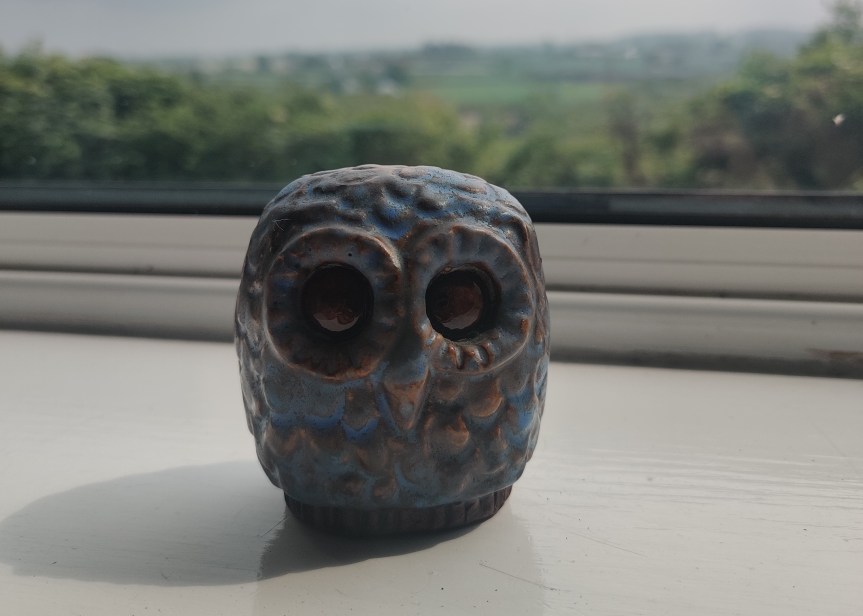
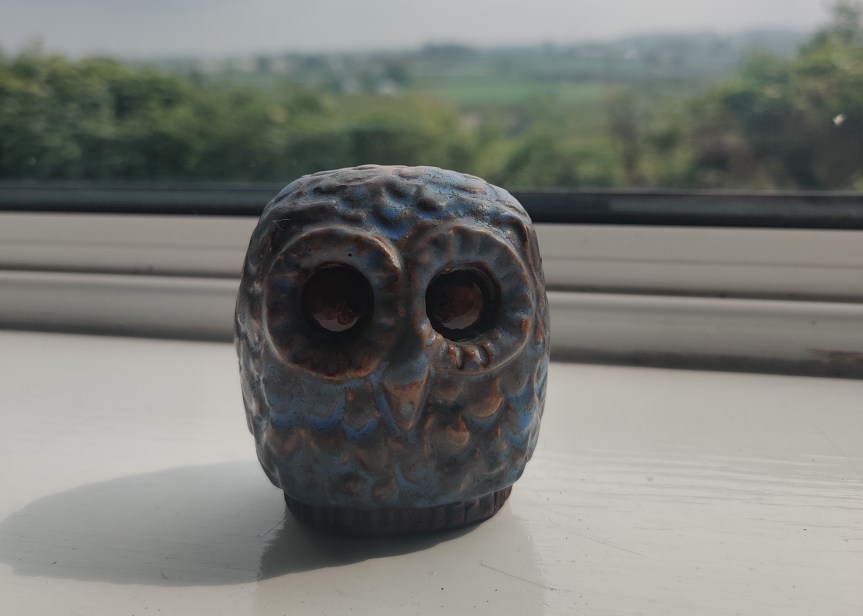
The owls remained, till she passed some years later. They’re now scattered, in a way that things often are when they’re inherited. I picked my favourite (probably Beethoven) – a small blue ceramic one with round, kind eyes and big bushy eyebrows, the number 12 in black marker pen on his bottom. My brother has Mozart, the fluffy hug.
The list is long gone and I’ll never associate owls to music the way Morfar did. But I have named the tawny owl that visits our telegraph pole every evening Beethoven. I think Morfar would have approved.
Hanne Larsson is a Swede who longs for her childhood’s 95% humidity and hawker centre food. Her stories are fed by moss-covered rock-trolls and what-if scenarios; her non-fiction by nature and what places do to people (and they to them). She is currently completing an MA in Nature and Travel Writing at Bath Spa University.
Birds of Firle is a single edition book by Tanya Shadrick being posted sequentially to 100 collaborators around the world, inviting responses to the idea of Grief and Hope as the things with feathers. Each recipient spends a few days with the book, before returning it with a hand-written letter and other small artefacts.
 selkiepress.com