Birds of Firle: She Was Always in Flight by Nicola Pitchford

Aerodynamics was her chosen field of engineering. She worked on the Harrier, the Concorde. She had a love of speed and freedom. Sports cars. Like the one in which eventually she fled. Flew. From marriage and family. From us.

When my mother was old, I wrote about her hair as fine white feathers, drifting about her face as she lay on her back each day in the pool, arms outstretched, gazing at the blue southern sky and the whirling Mississippi kites.

She was always associated with flight. 

Aerodynamics was her chosen field of engineering. She worked on the Harrier, the Concorde. She had a love of speed and freedom. Sports cars. Like the one in which eventually she fled. Flew. From marriage and family. From us.

When I was young, we lived in a house on a wooded hilltop, named for birds. Three Jays it was called, and sometimes we’d find one of their extraordinary blue, iridescent-barred feathers in the garden, caught in the hedge or the crabapple tree, and we’d bring it inside to her.

All her birds were hilltop birds. But jays are woodland birds; ours are the birds of open sky.

If you were to ask me for a memory of perfect happiness, it would be this: a day of sun and scudding clouds, lying on our backs in the grass on a chalk hilltop, somewhere near the ancient White Horse. Me and her. Listening to skylarks.

It really happened, once or twice, or maybe half-a-dozen times that condense into one. The last was a deliberate, conscious recreation on my part, perhaps as late as 15 years ago, the last time we walked the Ridgeway together. Even then, I was secretly seizing back time and joy against all the years we’d been apart from one another, after she left – and all the years to come, when she would soon be absent again. Most of my life, caught between two mournings. Trying to replay and freeze an image, as sweet and fine and needle-sharp as a skylark’s lifting song on the wind.

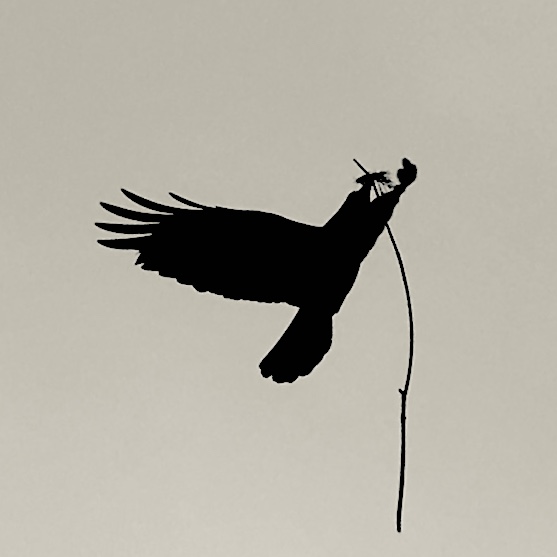
Ravens were hers, too. Not the white feathers of her fine-silk hair but absolute and densely black. Both of us claim our true home in the windy places where ravens are. Once we were walking here in Northern California, on the hill I love best, on one of those fiercely blustery winter days when the landscape plays tricks on me in its brief phase of greenness and lowering skies – making my sense of place flicker between here and somewhere along the Pennines or perhaps the Cumbrian fells. Each of my two beloved places interlayering with the other, as if belonging could be as multiple in its objects as love is.

We watched three ravens diving and floating in the hilltop wind, disappearing into the canyon then reappearing together or disparately, passing beside us or above. It was one of her witchy moments, when I knew she was a scientist who would settle for whatever brutal bed she’d made – but also a mystic who knows full well there is more. ‘Have you ever seen a raven roll?’ she asked. ‘I love it when they roll.’ I never had, not for all the times I’d been up there on the ridge in every weather. And at that moment, one of the three dark birds passed close above us and rolled. For nothing but the pure, impractical pleasure of it. The freedom.

It was probably up there, one time or another, that she said she wanted to come back as a raven maybe, or yes, a great raptor. A hawk or eagle. A bird that needs no flock. That moves without apparent movement. That rides the currents of the air, the warm upswells, knows both the play and the science of air, fierce and majestic and profoundly free.

Perhaps the closest she came in this life was training for her pilot’s license, at last, when she had retired and she and her husband were rampaging through the money she’d finally inherited after decades of scrabbling and odd jobs that she always had to hide her credentials to secure. Way back when she’d had her brief, proper career in aircraft design, only the men were taken on test flights. No insurance for women, they said. Gave her a box of Black Magic chocolates instead.

But she never did fly solo, having decided at the last testing hurdle that she was really too old. I suspect it wasn’t really a choice about practicality; it was more about her husband’s wanting to spend the rest of the money on a too-big house in a warm place, with that swimming pool. With the Mississippi kites circling overhead. And her fine white-silk hair drifting about her in the blue water like feathers, which I know it did because I was the one eventually who brushed it out on her pillow, brushed it out with my fingers each night, again and again. As I bent to listen for the weightless lift of her breath.
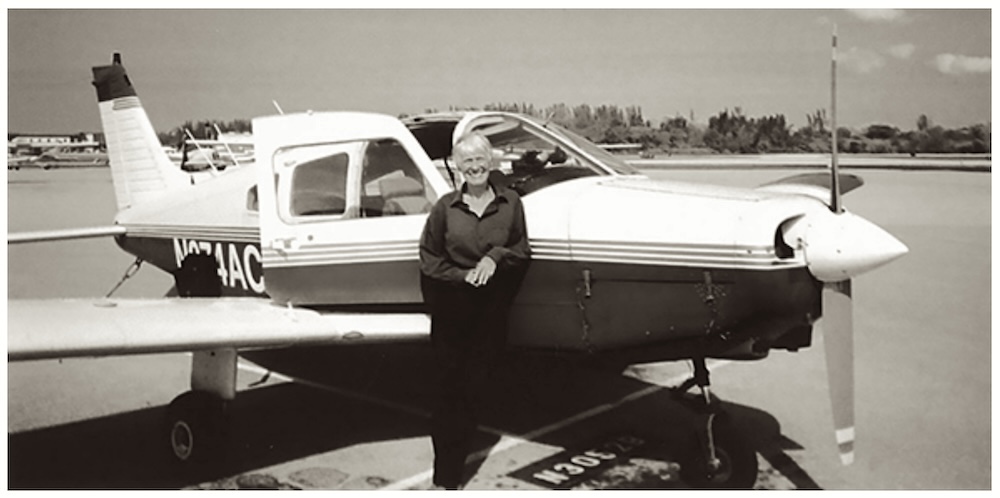
Nicola Pitchford is a nature writer and academic who was born in the UK and immigrated to the US — and has been confused about landscape and belonging ever since. She lives in the hills of Northern California, on the ancestral land of Coast Miwok people. Her essay about her father’s career in water engineering and his love of desert places, “A Parable of Arable Land,” won the inaugural (2022) Nature Chronicles Prize. She is at work on a book about her early separation from mother and motherland and the attempt to recreate both relationships.

You can order a print copy of The Nature Chronicles anthology – which includes Nicola’s winning essay ‘A Parable of Arable Land’ – from Sarabande Books.


Birds of Firle is a single edition book by Tanya Shadrick being posted sequentially to 100 collaborators around the world, inviting responses to the idea of Grief and Hope as the things with feathers. Each recipient spends a few days with the book, before returning it with a hand-written letter and other small artefacts.
Enter your email to sign up

Birds of Firle: The Windowsill Owls by Hanne Larsson

Clean-swept concrete steps  led up to the yellow, three-storey, timber-clad house which contained – for most of my childhood – the lives of my favourite grandparents. The interior was resolutely adult, with a small concession in the form of a couple of board games for children, and then, when they bought a video player (then DVD), two Disney animated films and the best Marx Brothers one.

With each visit, Mormor taught us more elaborate baking skills, soothed grazed knees, gave us manicures.

Morfar, meanwhile, would boom around the house – his cough some odd psychosomatic legacy from a cold or tuberculosis encountered as a child. You would hear him rumble and brown-bear shuffle round all levels, taking up all the space in a house built with too many rooms and eaves-storage tucked away where we played hide and seek, nostrils filling of fur and mothballs.

They collected things. I’ve since learnt all adults do. Some inherited, like the silverware; other pieces a joint choice, like the handblown wine glasses (only ever two of each, because they were a unit that way). And one collection that was Morfar’s alone.

His owls.

Ceramic or wooden, large or small, naturalistic or with just an owl-shaped hint. They lived on the sitting room windowsills, particularly ordered, nestled amongst floral curtains and framed by the largest, most uncomfortable armchairs known to exist. There were about fifty by the time he died, all numbered on their bases, their position ascertained.

My brother and I were fascinated by this collection. We were allowed to touch, but they were only ever to be returned to their singular perch. There was never a speck of dust on them.

I asked once, if I was allowed to buy him one, but it was a resolute no; this would always be his to manage.

Morfar was not a bird-watcher in the way we think of people who may collect birds, either with binoculars and lists or as pets. He could name birds, sure, but in the way by which humans engage with the natural world, nothing more. He had no more a hankering to collect birds than stamps – except for his owls.

These owls were named and numbered after his favourite composers, the list sketching out each owl’s outline and position in the flock. We thumbed this list regularly, trying to remember which owl was who, a children’s game of memory in a house not conceded to our ages.

Windowsill Owl by Hanne Larsson for Birds of Firle

Each owl’s look corresponded to how a composer’s music made him feel: Mozart (his favourite) was like a fluffy hug; Tchaikovsky and his discordant compositions represented an angry-looking screech owl. It was never clear beyond their positioning whether there was some big orchestral piece to consider, and we never asked, those birds fading into things we just accepted was the way with our grandparents.

When they sold up and moved out of Stockholm, the owls followed, new windowsills inhabited but following the old list’s order. There was only ever one conductor.

Mormor kept everything as it was after he passed; grief does those things to you, I guess. Their flat boomed less, there was more space for her in turn, though I don’t think she ever saw that way, even as the rest of us noticed her emergence.

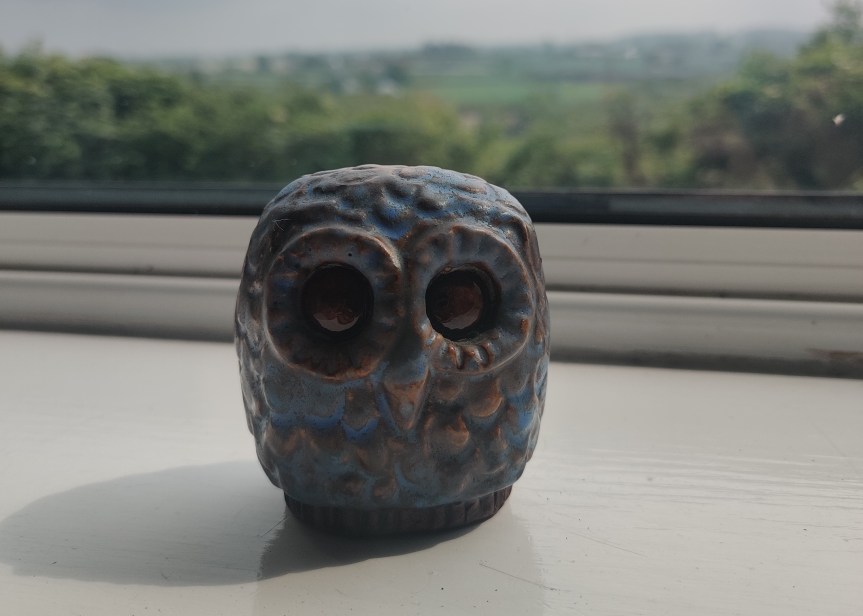
The owls remained, till she passed some years later. They’re now scattered, in a way that things often are when they’re inherited. I picked my favourite (probably Beethoven) – a small blue ceramic one with round, kind eyes and big bushy eyebrows, the number 12 in black marker pen on his bottom. My brother has Mozart, the fluffy hug.

The list is long gone and I’ll never associate owls to music the way Morfar did. But I have named the tawny owl that visits our telegraph pole every evening Beethoven. I think Morfar would have approved. 

Hanne Larsson is a Swede who longs for her childhood’s 95% humidity and hawker centre food. Her stories are fed by moss-covered rock-trolls and what-if scenarios; her non-fiction by nature and what places do to people (and they to them). She is currently completing an MA in Nature and Travel Writing at Bath Spa University.


Birds of Firle is a single edition book by Tanya Shadrick being posted sequentially to 100 collaborators around the world, inviting responses to the idea of Grief and Hope as the things with feathers. Each recipient spends a few days with the book, before returning it with a hand-written letter and other small artefacts.

Enter your email to sign up

Birds of Firle: Words He Gave Me by Annick Yerem


Grief is a language we don’t speak until we have to, with as many variations as you could imagine.

I had already been grieving for so many years, that I thought I was an expert at it. The grief over my healthy body, gone forever, the grieving for the life that could have been. The grief when my son left for Uni and I felt my last purpose was gone.  The grief when my parents got sicker and sicker. The grief when my Dad didn`t recognize me for the first time.

All the unkind firsts.

So when my father died in July 2020, in that strange and horrifying year, I expected to be calm and collected and prepared. But nothing had prepared me for how stressful it would be, how breathtaking and sometimes beautiful my interactions with people would be, how it would crush me and make me laugh and cry and be furious, all at the same time.

The visit to the funeral parlour, where I had to choose an urn and was actually happy to find one that looked vaguely Japanese and not as horrid as the other ones, some of which were adorned with rhinestones, poppies at sunset, that kind of thing (let me tell you, it´s a whole new level of surreal when you get complimented on your choice of urn at your Father`s funeral). The moment I brought them the clothes I wanted him to be cremated in and the woman didn`t know how to tie a kimono, so I had to put it on and show her how. The way she handled my grave gifts with such care: the kimono, the otter t-shirt, the pipe and the tin of tobacco. I felt as I if I was providing safe passage for my own pharaoh in the making.

The woman at the florists whose eyes lit up with delight when I told her I wanted a green wreath and sunflowers and who exclaimed when she saw his photo: ‘I feel that that suits him so well!’

The moment I walked towards the church with my son that morning, the way it smelled of the South of France, of pines and figs and sunshine.  How the tenor practicing the songs for him inside the church sounded like an angel. And how everything fell into place, Bach and Mozart and Schubert, Dylan Thomas and Glyn Maxwell, M’s beautiful words, my letting go, his brother`s lovely eulogy including the accordion, the reverend who had listened to me and painted a picture that was more accurate than what I had expected, the lavender and rosemary we threw on the urn, the tree that has now grown with him, the bramble and rosehip hedges surrounding us, the August heat.

I woke up every night at 4.14 am after he died. After the funeral, it stopped. He sent birds to sing me back to sleep, but first he had to wake me up so that I wouldn`t forget him. He should have known that I remember everything he said to me, the good and the bad.

Grief is a language we don’t speak until we have to, with as many variations as you could imagine.

Sure, we know what it means, when someone dies. But do we? Her and I, we knew all of him. The kindness, the curiousity, the sense of humour. We also knew the temper, the harshness, the slamming of doors, the things that should have been left unsaid. People aren`t easy and he wasn´t either. When I was little, he was my hero, but as I grew older and his expectations weighed on me, we fought and fought, silly, pointless, horrible fights. The last few years though, I fought for him with all I had and I hope that somehow he knew that.

I need him to know that I took so many of the words he gave me and turned them into poems. There are traces of him everywhere.

The house welcomed and woke me with birdsong, and on the balcony were the frayed remnants of skeletons – two who were not so lucky last year. I dared not move them.

On our way to the sea, we saw hundreds of cranes flying to the south, seagulls canvassing the fields. I have to relearn all the birds she taught me when I was little, there are only a few now that I can name. Puffins and starlings, house martins, herring gulls, chicken, owls, buzzards. I keep the bottle of ‘Old Spice’ on my shelf, when I open it and close my eyes, I smell decades of memories.

I remember him and who I maybe was to him and who he was to me. I still do.

Listen on Soundcloud: A reading of St. Eisenberg and the Sunshine Bus, for iamb 

Annick Yerem was born in Japan to a Scottish mother and a German father. She is a poet and editor in chief of Sidhe Press. She wants nothing more right now than a permanent ceasefire in Palestine.


Birds of Firle is a single edition book by Tanya Shadrick being posted sequentially to 100 collaborators around the world, inviting responses to the idea of Grief and Hope as the things with feathers. Each recipient spends a few days with the book, before returning it with a hand-written letter and other small artefacts.

Enter your email to sign up

Birds of Firle: A Woman of Eighty Builds a New Life, Free of a Forty-Year Marriage

Rook and human,
all through the dark days
and nights of winter.

Bird and woman.
Fight to stay; trees bend
in the wind and rain.

Bird unsteady on the branch.
Human resents new house.
How to make a home?

As always
Spring arrives.

Bird is busy
Twigs in beak to chosen spot
To-ing fro-ing, placing here and there.

Inspection. Satisfaction.
Soon a nest awaits new life.

Much to do in human house.
As with bird, renewing, replacing.
Hither, thither.

Green plants to this nest gathered.
Inspection. Satisfaction.

Human watches Rook across the road.
Here at last.
New life.

Editor’s note by Tanya Shadrick, founder of The Selkie Press: In the very last pages of my memoir The Cure for Sleep, the Late-Waking Life of the subtitle becomes my mother’s as well as mine. Like so many women of her time and place, she has never been encouraged to share her experience through art or writing. A year now into her new life, I invited her to risk her words for Birds of Firle – this decade-long and collective exercise in writing of grief and hope as the things with feathers. This poem is her beautiful contribution.


Birds of Firle is a single edition book by Tanya Shadrick being posted sequentially to 100 collaborators around the world, inviting responses to the idea of Grief and Hope as the things with feathers. Each recipient spends a few days with the book, before returning it with a hand-written letter and other small artefacts.

Enter your email to sign up

Birds of Firle: Jackdaws by Deborah Parkin

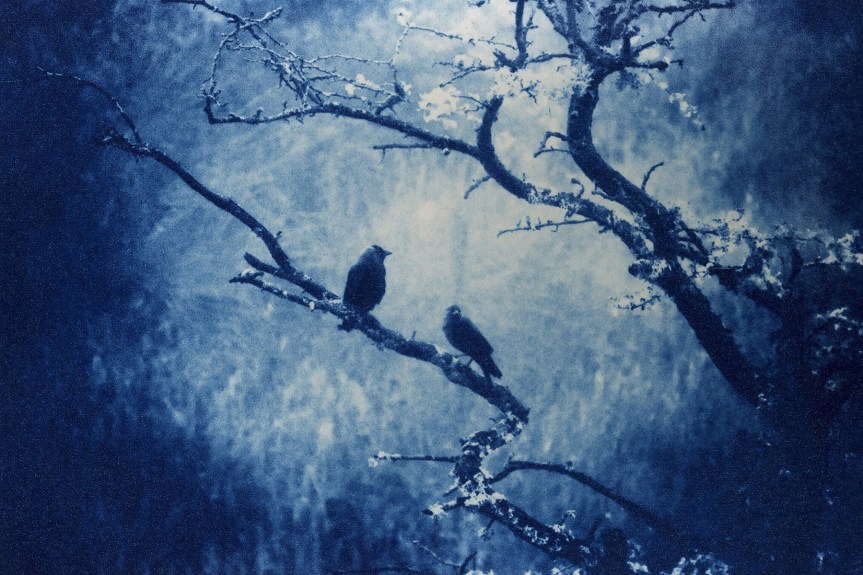
Grief, love, family, jackdaws, and the colour blue are the things that brought this project together.

He always thought he would go out in a blaze of glory – the rock and roll death of an alcoholic. It wasn’t like that of course. Instead, we witnessed him commit suicide in slow motion in the most unromantic of situations.

My relationship with my father was complex. My mum divorced him when I was four years old and he was in and out of my life until he died. I would see him some weekends – I would stay with him in his bedsit in Finsbury Park, where you shared the toilet on the landing with the other tenants. Or he would visit on a Sunday and I would sit at the end of the street waiting for him – more often than not, he didn’t make it past the pub.

It wasn’t until my early twenties that I accepted that my dad would never remember my birthday and he would always need a drink to survive, even if it would kill him. When he died, he died in pain, ungraciously. In my journal I have written that I believed as he lay dying, he had changed his mind – he wanted to live – but it was too late. This still haunts me.

My father died from cirrhosis of the liver. When he phoned to tell me his liver was damaged, I asked him to stop drinking. I will never forget his words, he said: ‘I stopped smoking for you, I’m not going to stop drinking. What do you expect me to do, sit and stare out of the window every day?’

And I thought: he’s right. What else would he do; how else would he spend his time? He was unreachable, he was never going to exorcise his demons when he could drown them.

My father was taken into hospital and my sister and I flew to Ireland to be with him. He was unrecognisable – his black hair was shockingly white; he had lost his teeth and seven stones in weight. He had onset dementia and was crying out in pain. The last words I can remember him saying was that he wanted to go outside and feel the cool breeze on his burning skin. I hadn’t expected him to die in front of me.

After a few surreal days of a full blown Irish Catholic funeral which included a procession down the street that he had grown up in and sitting with his dead body in a room filled with strangers from the length and breadth of Ireland, I came home. I didn’t pick up my camera for the next 18 months, but I would sit and watch the Jackdaws in my quiet moments.

I hated them when I first moved here – in the morning I was greeted with their fearsome caws when I longed for the beautiful song of the blackbird. But the more I watched them, the more I fell in love with them.

The Jackdaws remind me of my enormous Irish family – one that I will rarely see now that my father has died. You often see them in pairs, sitting on the barn roof or on the wall – lovingly grooming one another. At other times you hear them screaming at one another and fighting over territory and food. Again, reminding me of my Irish family with its petty arguments and deep, deep love and loyalty. They remind me that life goes on, and life goes on.

They say that blue is the colour of memory, of dreams and if that is true then the cyanotypes have been created in memory of my father. The blue of the sky that I witness when I sit outside the pub with a packet of crisps and a bottle of coke, waiting for him to finish his drinking. The blue of his postman uniform. The blue on his dead lips.

Grief, love, family, jackdaws, and the colour blue are the things that brought this project together.

Deborah Parkin is a photographer living on the remote hills of the North Pennines. Her work is steeped in family and memory. She embraces many forms of photographic practice, including historical processes such as wet plate collodion, cyanotype, bromoil and silver gelatin. Before becoming a photographer she studied English Literature, did an MA in Holocaust Writing and taught in adult education. Her bird cyanotypes have most recently been featured in Collosal magazine and PetaPixel, one of the world’s leading photography journals.


Birds of Firle is a single edition book by Tanya Shadrick being posted sequentially to 100 collaborators around the world, inviting responses to the idea of Grief and Hope as the things with feathers. Each recipient spends a few days with the book, before returning it with a hand-written letter and other small artefacts.

Enter your email to sign up