Birds of Firle: The Windowsill Owls by Hanne Larsson

Clean-swept concrete steps  led up to the yellow, three-storey, timber-clad house which contained – for most of my childhood – the lives of my favourite grandparents. The interior was resolutely adult, with a small concession in the form of a couple of board games for children, and then, when they bought a video player (then DVD), two Disney animated films and the best Marx Brothers one.

With each visit, Mormor taught us more elaborate baking skills, soothed grazed knees, gave us manicures.

Morfar, meanwhile, would boom around the house – his cough some odd psychosomatic legacy from a cold or tuberculosis encountered as a child. You would hear him rumble and brown-bear shuffle round all levels, taking up all the space in a house built with too many rooms and eaves-storage tucked away where we played hide and seek, nostrils filling of fur and mothballs.

They collected things. I’ve since learnt all adults do. Some inherited, like the silverware; other pieces a joint choice, like the handblown wine glasses (only ever two of each, because they were a unit that way). And one collection that was Morfar’s alone.

His owls.

Ceramic or wooden, large or small, naturalistic or with just an owl-shaped hint. They lived on the sitting room windowsills, particularly ordered, nestled amongst floral curtains and framed by the largest, most uncomfortable armchairs known to exist. There were about fifty by the time he died, all numbered on their bases, their position ascertained.

My brother and I were fascinated by this collection. We were allowed to touch, but they were only ever to be returned to their singular perch. There was never a speck of dust on them.

I asked once, if I was allowed to buy him one, but it was a resolute no; this would always be his to manage.

Morfar was not a bird-watcher in the way we think of people who may collect birds, either with binoculars and lists or as pets. He could name birds, sure, but in the way by which humans engage with the natural world, nothing more. He had no more a hankering to collect birds than stamps – except for his owls.

These owls were named and numbered after his favourite composers, the list sketching out each owl’s outline and position in the flock. We thumbed this list regularly, trying to remember which owl was who, a children’s game of memory in a house not conceded to our ages.

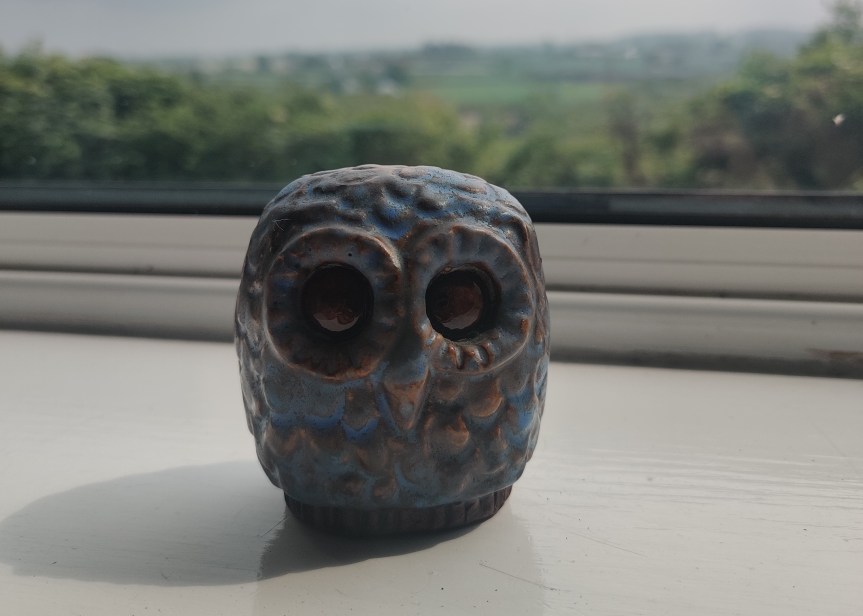
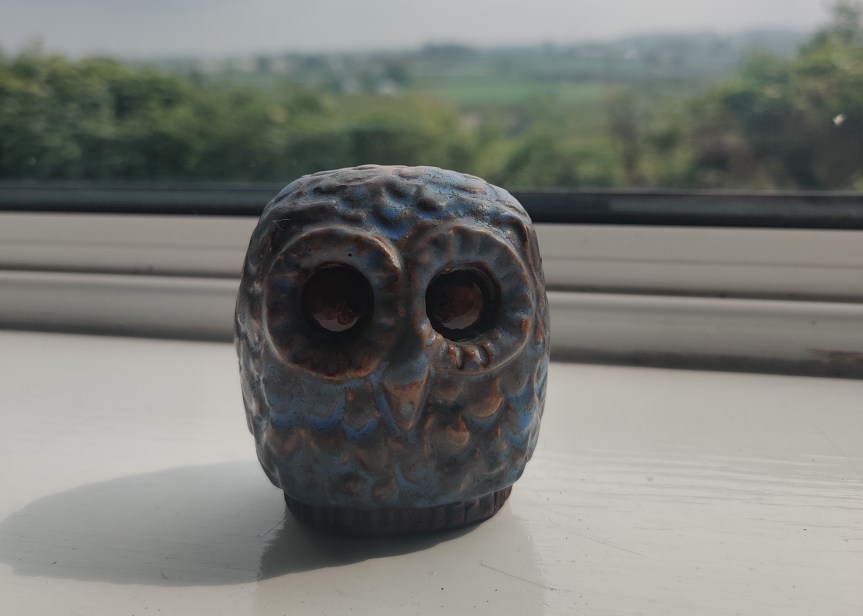
Windowsill Owl by Hanne Larsson for Birds of Firle

Each owl’s look corresponded to how a composer’s music made him feel: Mozart (his favourite) was like a fluffy hug; Tchaikovsky and his discordant compositions represented an angry-looking screech owl. It was never clear beyond their positioning whether there was some big orchestral piece to consider, and we never asked, those birds fading into things we just accepted was the way with our grandparents.

When they sold up and moved out of Stockholm, the owls followed, new windowsills inhabited but following the old list’s order. There was only ever one conductor.

Mormor kept everything as it was after he passed; grief does those things to you, I guess. Their flat boomed less, there was more space for her in turn, though I don’t think she ever saw that way, even as the rest of us noticed her emergence.

The owls remained, till she passed some years later. They’re now scattered, in a way that things often are when they’re inherited. I picked my favourite (probably Beethoven) – a small blue ceramic one with round, kind eyes and big bushy eyebrows, the number 12 in black marker pen on his bottom. My brother has Mozart, the fluffy hug.

The list is long gone and I’ll never associate owls to music the way Morfar did. But I have named the tawny owl that visits our telegraph pole every evening Beethoven. I think Morfar would have approved. 

Hanne Larsson is a Swede who longs for her childhood’s 95% humidity and hawker centre food. Her stories are fed by moss-covered rock-trolls and what-if scenarios; her non-fiction by nature and what places do to people (and they to them). She is currently completing an MA in Nature and Travel Writing at Bath Spa University.


Birds of Firle is a single edition book by Tanya Shadrick being posted sequentially to 100 collaborators around the world, inviting responses to the idea of Grief and Hope as the things with feathers. Each recipient spends a few days with the book, before returning it with a hand-written letter and other small artefacts.

Enter your email to sign up

Birds of Firle: Auguries of Harvest by Nicola Chester

In the year since my father died, new words and phrases have entered our language. There is a rich, etymological seam he would never hear: shielding, zoom, Coronacoaster, Covidiots, PPE, Clap for Carers, ‘rona, social distancing, furlough, Eat Out to Help Out. Our first year without him in it has been an extraordinary one. 

§

In the spring of last year, before Dad was ill, I discovered the shock of a dead heron by the side of the road. It looked as if someone had cut the strings on the ancient creaking of this pterodactyl-marionette. One great wing stretched up the bank, the other sweeping the road in an awkward final-curtain bow. The bird’s serpentine neck folded around its yellow, stickleback-harpoon of a bill, and the white neck feathers marked with black darts and red chevrons. A crumpled house of cards. I wonder if it had been shot and, after a stricken glide, fell, crashing Icarus-like into this pile of unglued feathers and hazel-pole legs. A thunder-cloud fall of woodpigeon sky.

Heron is a talisman bird for me. Spirit of my Grandad, scholar gypsy and Romany Rai, I picture him now, producing his worn, warm copy of The Observer’s Book of Birdsfrom his leather waistcoat pocket for me. He always said he’d come back as a heron. It suited him; his hunched wisdom and careful stepping. His windswept, jet mortarboard of hair. I still feel his influence, and I wondered what this dead bird might mean; this augury of significant feathers, like a collapsed tent. 

Book of Birds by Nicola Chester for Birds of Firle

It was near harvest time when we began to voice our concerns about Dad. The withdrawing. The far away-ness. Between jobs, my brother had come over by chance from Australia and, it being the summer, we had the gift of much family time together against the growing unease that something was wrong. Mum and Dad’s house is just a farm away in our village. We walked backwards and forwards through the process of harvest, the air hazed with the grey-gold of chaff and chalk dust. We walked over the folds and heights of the downs, when we weren’t looking after Dad. The birds had fallen into their harvest silence, moulting feathers, and we made a collection: red kite, buzzard, woodpecker. 

Throughout those days, from mid-afternoon onwards, a tawny owl called from Mum’s garden. I tried not to be superstitious. Roman ‘augurs’ would note the ‘auspices’ or behaviours of birds and try to predict what might happen. An owl calling in the daytime was a bad omen of a world out of sorts: one on the roof, certainly inauspicious – with a death in the house likely. But we liked the owl and by now, we thought we probably knew what was coming. 

It was still a shock, nevertheless, when Dad died within a month, just seventeen days after the diagnoses of an aggressive brain tumour. We’d broken him out of hospital and he died peacefully at home – a gift for the bereaved not granted to those who lost someone in 2020. 

The ravens, rooks and jackdaws gleaning the stubble seemed to shout the news with their Berkshire-accented, harvest warning ‘Oi! Boi!’ Fyre, barn, fyre barn.’ Dad had been a fireman.  What followed was a year of birds and grieving. Quietly at first; the kite’s mournful whistle on fog-shrouded days; the robin’s notes from the tangled miles of traveller’s joy or ‘bedwine’ that wound through the hedges like an elaborate handrail I needed to get me away from home and back again – even the feathered seeds are curled around their central globe like tiny ostrich plumes.  

Most poignant were the song thrush’s strident, repeated phrases that began on the midwinter solstice and carried me through and beyond the midsummer one, through all the birdsong of the most beautiful, blossomy spring in living memory. Our Covid spring, our global plague year, our year of hope for change; my first year without Dad in it.

As harvest began to swing round again and the birds moulted their feathers and fell into a late summer silence, a new anxiety bloomed. Two of our three children’s immediate futures were to be decided by a faulty, unequal system that would not favour their small, rural comprehensive education.  During an unsettling, unprecedented heatwave, more new words entered our language along with overwhelming uncertainty: algorithms, tropical nights, masks. 

Autumn in the time of Coronavirus by Nicola Chester for Birds of Firle

I wonder what Dad would have made of it all. How he would have reacted. He would have marched on someone over the exam debacle, certainly. His whole life was about protecting family. 

As harvest and the anniversary of our losing him came round, a pair of barn owls moved into the oak tree near the house. I saw them nuzzling up to one another and one bright, September morning, picked up a feather beneath the branches. The light shone a white gold through it. It felt like an exhalation. We could hope, perhaps, for owlets next year. The two eldest children got the exam results they needed and we prepare for another leaving. Our son, spreading his wings and leaving the nest for University. Dad would’ve been so proud. 

Nicola Chester lives and writes in the kitten heel of the Berkshire ‘shoe’, at the heart of the glorious North Wessex Downs and half a mile from both the Wiltshire and Hampshire border. She is the RSPB’s first and longest-running female columnist in Nature’s Home Magazine and a Guardian Country Diarist.


Birds of Firle is a single edition book by Tanya Shadrick being posted sequentially to 100 collaborators around the world, inviting responses to the idea of Grief and Hope as the things with feathers. Each recipient spends a few days with the book, before returning it with a hand-written letter and other small artefacts.

Enter your email to sign up

Birds of Firle: What Birds Fly With You by Patrick Limb

What birds fly with you,
ibis or swallow,
we do not know
nor how light the feather
to weigh against your heart

Last lines from
‘Elegy for the Mummy of a Young Girl
in the British Museum’ by Frances Horovitz


The heart, not the brain, is the record-keeper. It holds the memory of good and bad deeds; and of things left undone. Such was the belief of the ancient Egyptians. For that reason, one precept of their Book of Coming Forth by Day, with its Spells of the Dead, was that the heart (though an organ vital to life) was the key to the afterlife. The heart fell to be weighed in the scales against the feather of Maat. If the heart weighed more, then woe betide.

When Italian explorer, Giovanni Battista Belzoni discovered the sarcophagus of Seti I in 1817, the great King had been dead over 3,000 years. He ruled Egypt from 1294 to 1279 BC. Carved from a monolithic block of alabaster, Seti’s sarcophagus stood in the tomb’s largest hall, deepest of all that dynasty’s royal tombs in the Valley of the Kings. Fifteen years a pharaoh, how heavy the feather to weigh against his heart?
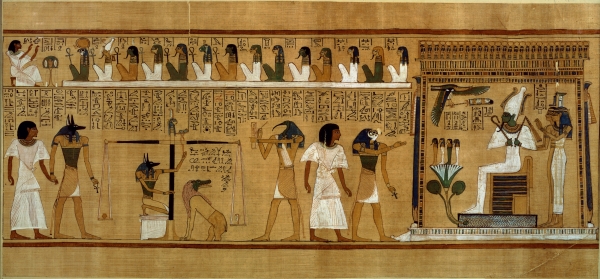
The Weighing of the Heart against Maat's Feather of Truth, from the Book of the Dead of the Royal Scribe Hunefer, New Kingdom, c.1275 BC (papyrus) Bridgeman Art Library

Inside and out, the sarcophagus bore inscriptions from the ancient Book of Gates, charting the journey of a soul through the Egyptian Underworld. The lid of the sarcophagus used to feature a sculpted portrait of the dead king. It was removed by tomb robbers. To borrow from Emily Dickinson, even the mighty ruler was not “safe in his alabaster chambers”.

Eight years later, in 1825, Sir John Soane caused a large hole to be knocked in the rear-wall of his house at 13 Lincoln’s Inn Fields, London.  This was to allow safe passage of the same sarcophagus into the underworld of his home. He had paid £2,000 for it. How much lighter then his wallet?  Soane was resolved to make this tomb the very centrepiece of his collection in the ‘Sepulchral Chamber’, as he styled it. To celebrate the arrival, Sir John hosted not one but three parties, having succumbed to unchecked enthusiasm for showing off the last resting place of King Seti. An act of ostentation yes, but something more too. The design of the lighting, some of it within the sarcophagus, was supervised by Soane himself. Light forming shade, light contrasting the shades to create an atmosphere, it was said, thick with romance and melancholy.

All of this would have delighted my father. He was alternately quixotic, morbid and exuberant. On high days, he succeeded in being all three at once. Visits to a “good ruin” (in truth, he never considered there could be such a thing as a bad ruin) would ritually be accompanied by gales of his gallows’ laughter, rising up from subterranean crypt or dungeon. Drawn to the lustre of funerary objects, in 1972 he stood long in the queue to gaze on Tutankhamun’s bright mask, then at the British Museum.  So theatrical a name as ‘Sepulchral Chamber’ was a lure he could not ignore. He gazed too on the alabaster of King Seti’s sarcophagus, now darkening to a buff colour on account of London climate and pollution. Like Sir John Soane, it would not have occurred to him that other people might not be as elated as him by what they saw.


§


I was dead you see”, my father began, in the telling of his dream to his sons. He described how, dressed in simplest plaid, he found himself on a bare, parquet floor in a grand house. On that floor were set three wooden objects: a piano, with its stool; and a coffin. Though he was laid out in the latter, he so wanted to sit at the former that he quit his coffin and went to the keyboard. There, in this reverie, he looked  down to see his hands playing. What he witnessed were his fingers flying between octaves. He was performing Busoni’s transcription of Bach’s Chaconne in D Minor. This, for him, was the part that was all dream. Gifted though he was as a pianist, mastering the central sections of the piece had in life eluded him. Yet, there he was, using all but the last of his energies to be dazzling, note-perfect, playing the unplayable.

Anthony Patrick Limb - his piano (for Birds of Firle)

Just bars from the end of the piece, he could hear a noise in another part of the house. Until then, absorbed by the music, he had not considered whether others could hear this recital.  “I was dead you see”,  he said again. Not to cause distress to the keepers of that house, fearing they would find him slumped across the piano when they knew him already dead, he stopped playing. Back in the coffin, he laid himself out. Now, looking up, he saw one angel, and then another and a third. Staring harder, he noticed that this heavenly host was but a drawing on the inside of the lid to the coffin. Just as it closed shut upon him, he heard his last words to be: “Damn, I will never know”.

Whether there are angels, winged or not, in this life or the after-life, was a matter of some anguish to my father. Like the Victorian poet, Francis Thompson, he found himself chased by The Hound of Heaven. Those words “Damn, I will never know” spoke to that doubt. He found that living with hope was harder than coping with despair. He was, on balance, more unbeliever than not when it came to faith in the hereafter.


§


What were my father’s last words? Knowing him, with a baleful tone: “We’re going to be late”. Though “Old age should burn and rave at close of day”, that was not his death. He did not even make it to close of the day, let alone old age. In the afternoon of the 4th of July 1986, he just dropped down dead, aged 49 years. His dear heart, the record-keeper, had forgotten how to keep beating.

I am writing this 34 years later, to the day. It is the first time I have written, at any length, about him. The last time he wrote to me, at any length, was on my birthday. He wished me: “Success as the world counts it, the joy of friends, the dream of love and the consolation of equanimity”. No mention there of hope. The romantic, the disconsolate romantic present in “the dream of love” – not a wish for me to find love, at best, the “dream of love”. And then that last phrase: “the consolation of equanimity”. What a thing to wish an eighteen-year old.

In setting these words down, I find not so much grief, as an undiminished sense of feeling aggrieved. There was raw grief. It was some years before I could listen to his music without tears. Bach in particular set them flowing. But now, more a sense of grievance abides: at his loss and at my loss of him. Sharing his sense for the morbid, I worked out some years ago the day when son would have out-lived father: not a competition, just being marked by a marker in time. Now more years still have passed; more than half of my life without him; approaching three-quarters of his span in this world, since his death.
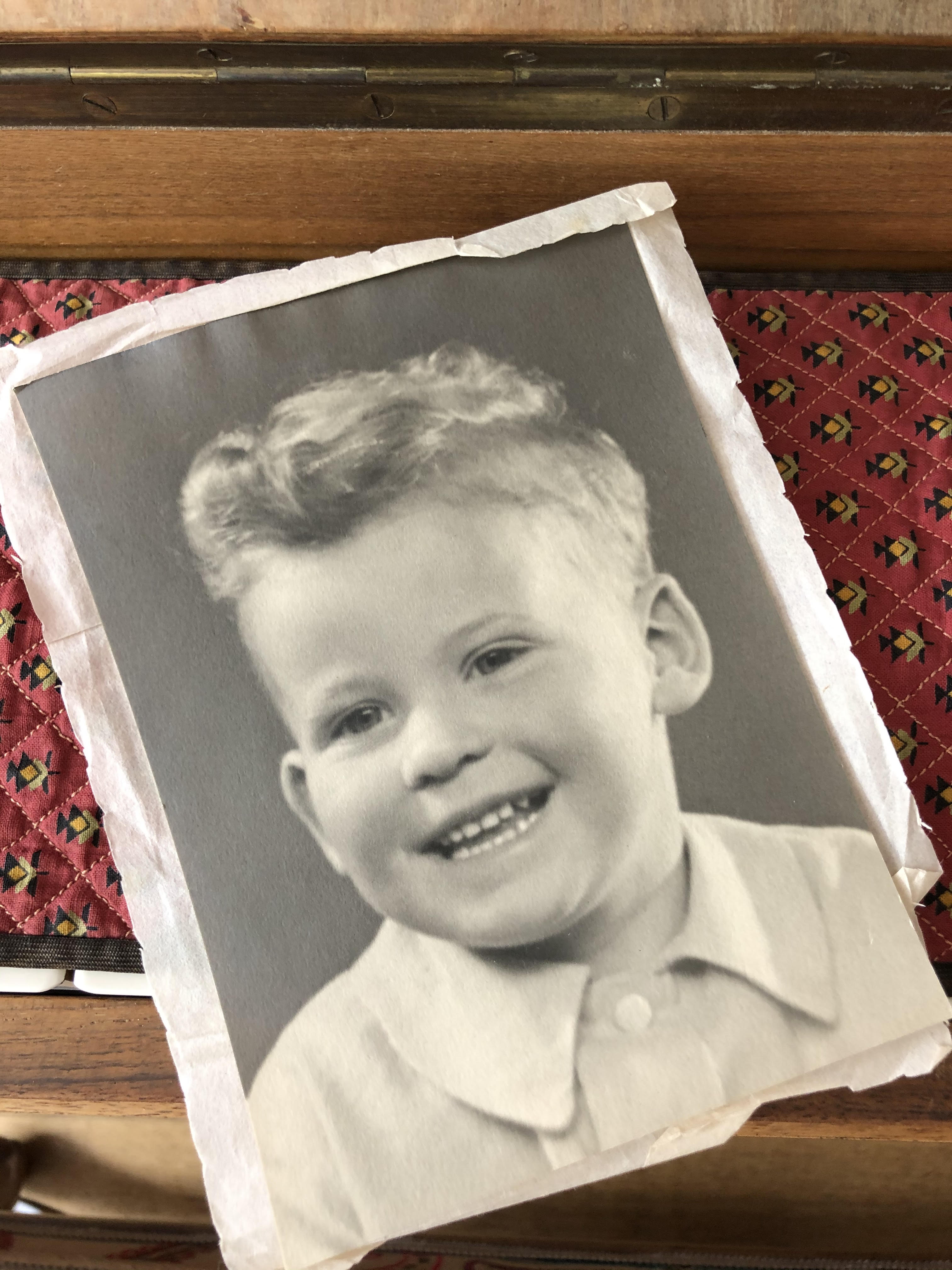
Anthony Patrick Limb as a boy for Birds of Firle

As well as Egyptology, my father loved etymology.  Let me then, as an act of memoir, retrace the steps of these words back to their origins. Aggrieved comes from the old French, ‘agrever’, to make heavier – in turn, from the Latin of the same meaning  ‘aggravare’ – all the way back to ‘gravis’ heavy. Set that against the family death notice, “… with a heavy heart, it grieves us…”. Grieves is from the old French, ‘grever’ to burden, encumber, and before then the Latin ‘gravare’, back once more to ‘gravis’. These words, cut from hard material, are now engraved.

That loss, the space left, becomes a burden, this is an etymological twist he would have enjoyed. Being a mathematician he knew how to turn a minus into a plus – and back again. As an actuary, he weighed Life Tables, more than the Spells of the Dead. But he would have seen that “feather” and “father” are close words, the latter just one vowel lighter. My grievance is not a cause for grievance. It is just another way of the heart keeping record that, having once been in the world, my father will always have been in the world.  He was right to wish for the “consolation of equanimity”.

In memory of Anthony Patrick Limb
(5 October 1936 to 4 July 1986)


A P Limb was a son of Nottinghamshire, gifted not only with a facility for numbers and words but also music; he heard and saw the harmonies between all three. Possessed of a singular flair for blagging his way to performing on keyboard instruments at stately homes (harpsichords being a particular draw), he once even managed to persuade the keepers of the Great Organ at Chartres Cathedral to play a few bars.

P F Limb is his elder son and works as a barrister in the same county, where he serves on the Nottingham UNESCO City of Literature Board. He is the keeper of his father’s piano, a Pleyel upright and really likes words, especially ones with animus such as equanimity and magnanimity.


Birds of Firle is a single edition book by Tanya Shadrick being posted sequentially to 100 collaborators around the world, inviting responses to the idea of Grief and Hope as the things with feathers. Each recipient spends a few days with the book, before returning it with a hand-written letter and other small artefacts.
Enter your email to sign up

Birds of Firle: Wings of Desire by Neil Gower & Anja Steinig

I often take feathers home. When I feel a deep wish, I entrust it to a feather,
which I hang on the grating of my balcony door. From there it can carry
my wish to heaven. 
Even stronger than a feather for me
is the wooden wing my lover sent me at the beginning of lockdown.
I hold it in my sleep every night.
–– Anja Steinig

A two-handed tale from new lovers
kept apart by Coronavirus

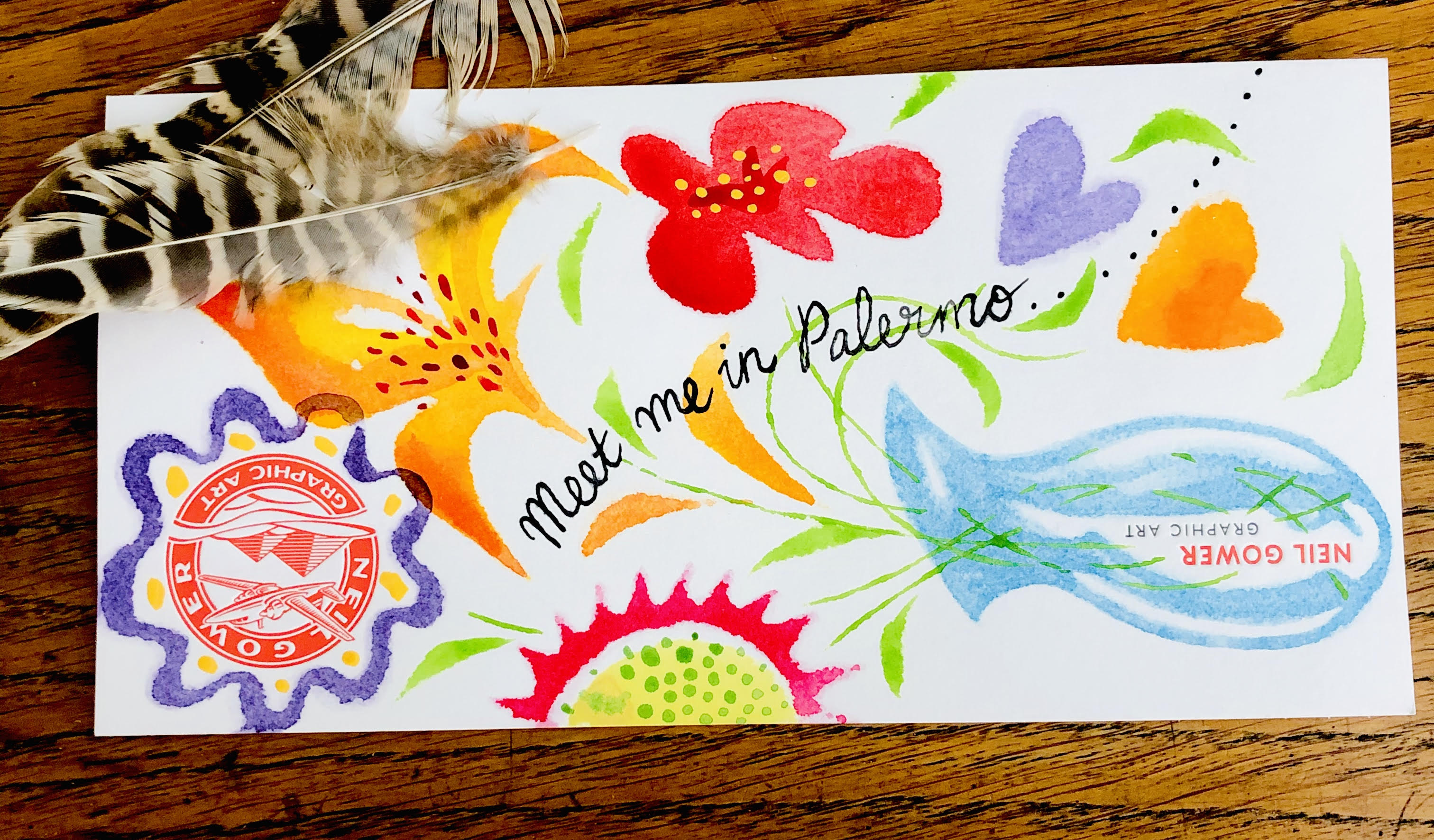
When Goldelse…

…pings into my phone on a Sunday evening I know Anja is nearly home. It is our sign. She sends a photo of the winged figure, snapped through the windscreen while waiting at the lights.

Goldelse by Anja Steinig

In fifteen minutes she will pull up Falckensteinstraße. It will take her five more minutes to carry the bags and the leftover food up to the apartment, then another fifteen to find a parking space this side of the Görlitzer Park and to walk home. After unpacking, she will shower off the weekend’s work and the Witzke earth. This week, a few kilometres into the journey home, she stopped to fill a bag with elderflowers that grow beneath the darkest night sky in Germany. These must be placed in a large bowl of water with sliced lemons, to steep overnight in readiness for making jelly with her daughters tomorrow.

Only when all this is done can we relax and prepare the risotto. We each stand a phone beside the stove and begin as we do each week: with a smile of tender longing, two glasses of robust red raised to screens across a locked down continent, reminding us of January in Palermo. Where we knew.

–– Neil Gower

Neil Gower for Birds of Firle

Here in Kreuzberg…

…the residents put everything on the street that is no longer needed. They know that somebody will take it away. On a warm summer evening, a walk through the neighbourhood can throw up many treasures. One comes with new pots and books or with old registration cards of a Berlin library (what I am writing on now). These cards represent so many stories: Not just those of their books, but also the stories of the people who borrowed them. But that must be at least 30 years ago.

As diverse as the treasures of the streets are the inhabitants of all ages, nationalities and preferences. There are also many strange birds living here, some shimmer like birds of paradise. Some lose feathers, like one I found the other day that does not help with flying, but is more for display. It is good to imagine it when it was speeding with its owner through the nights of Kreuzberg.

I often take feathers home. When I feel a deep wish, I entrust it to a feather, which I hang on the grating of my balcony door. From there it can carry my wish to heaven.

Even stronger than a feather for me is the wooden wing my lover sent me at the beginning of lockdown. I hold it in my sleep every night. My great love – who lives 1000 kilometres away from Berlin – also has one. We send each other pictures of these wings, each to each, to remind ourselves dass wir zusammen sind. Mit unseren Flügeln können wir gemeinsam überall hinfliegen*

–– Anja Steinig

Anja Steinig for Birds of Firle

* …we are together. With our wings we are able to fly together anywhere.

Neil Gower is a Welsh-born graphic artist and poet. He has two sons and lives in Lewes, at the heart of the South Downs, where he runs on chalk.

Anja Steinig founded her design practice, Studio F, in 2009. She also teaches typography and graphic design at several universities. For nine years she has been a board member of the Art Directors Club Germany, heading its editorial section. She has two daughters and lives in Kreuzberg, Berlin.


Birds of Firle is a single edition book by Tanya Shadrick being posted sequentially to 100 collaborators around the world, inviting responses to the idea of Grief and Hope as the things with feathers. Each recipient spends a few days with the book, before returning it with a hand-written letter and other small artefacts.
Enter your email to sign up

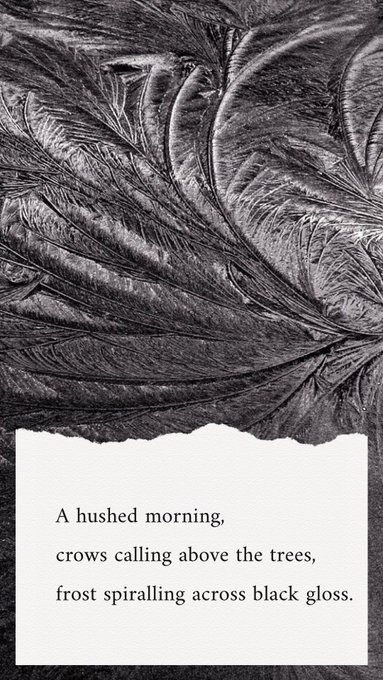
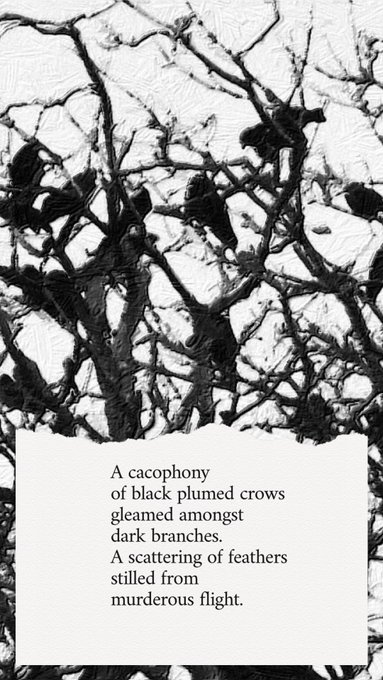
Birds of Firle: Crow Road by Laine Thompson

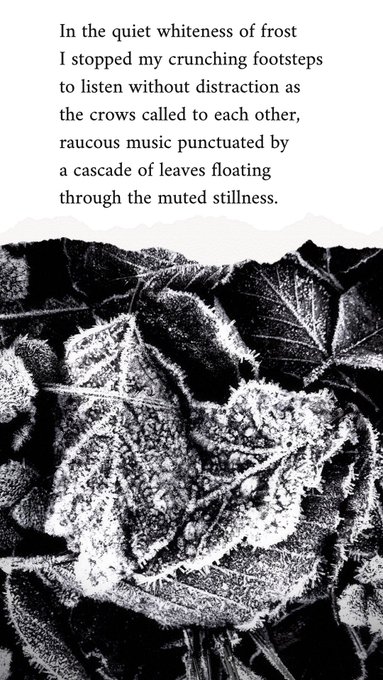
Crow Road 1 by Laine Thompson

Crow Road 2 by Laine Thompson

Crow Road 3 by Laine Thompson

Crow Road 4 by Laine Thompson

Crow Road 5 by Laine Thompson

Crow Road 6 by Laine Thompson

Crow Road 7 by Laine Thompson


An animation of this work, including audio, can be viewed on Twitter

Laine Thompson’s daily walks are a ritual that have become a way of caring for soul in the ever decreasing circles of present life. She does not set out with a fixed purpose, following instead time and tide and seasons: photographing anything that captures her attention, and using it as a springboard for imagination. You can see her responses to the natural world @marlinhoister 

Enter your email to sign up