Birds of Firle: The Windowsill Owls by Hanne Larsson

Clean-swept concrete steps  led up to the yellow, three-storey, timber-clad house which contained – for most of my childhood – the lives of my favourite grandparents. The interior was resolutely adult, with a small concession in the form of a couple of board games for children, and then, when they bought a video player (then DVD), two Disney animated films and the best Marx Brothers one.

With each visit, Mormor taught us more elaborate baking skills, soothed grazed knees, gave us manicures.

Morfar, meanwhile, would boom around the house – his cough some odd psychosomatic legacy from a cold or tuberculosis encountered as a child. You would hear him rumble and brown-bear shuffle round all levels, taking up all the space in a house built with too many rooms and eaves-storage tucked away where we played hide and seek, nostrils filling of fur and mothballs.

They collected things. I’ve since learnt all adults do. Some inherited, like the silverware; other pieces a joint choice, like the handblown wine glasses (only ever two of each, because they were a unit that way). And one collection that was Morfar’s alone.

His owls.

Ceramic or wooden, large or small, naturalistic or with just an owl-shaped hint. They lived on the sitting room windowsills, particularly ordered, nestled amongst floral curtains and framed by the largest, most uncomfortable armchairs known to exist. There were about fifty by the time he died, all numbered on their bases, their position ascertained.

My brother and I were fascinated by this collection. We were allowed to touch, but they were only ever to be returned to their singular perch. There was never a speck of dust on them.

I asked once, if I was allowed to buy him one, but it was a resolute no; this would always be his to manage.

Morfar was not a bird-watcher in the way we think of people who may collect birds, either with binoculars and lists or as pets. He could name birds, sure, but in the way by which humans engage with the natural world, nothing more. He had no more a hankering to collect birds than stamps – except for his owls.

These owls were named and numbered after his favourite composers, the list sketching out each owl’s outline and position in the flock. We thumbed this list regularly, trying to remember which owl was who, a children’s game of memory in a house not conceded to our ages.
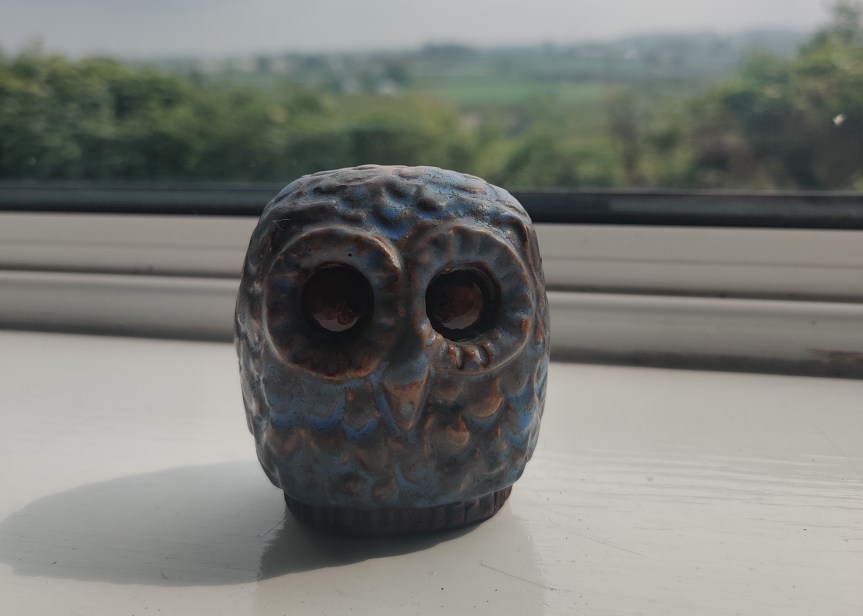
Windowsill Owl by Hanne Larsson for Birds of Firle

Each owl’s look corresponded to how a composer’s music made him feel: Mozart (his favourite) was like a fluffy hug; Tchaikovsky and his discordant compositions represented an angry-looking screech owl. It was never clear beyond their positioning whether there was some big orchestral piece to consider, and we never asked, those birds fading into things we just accepted was the way with our grandparents.

When they sold up and moved out of Stockholm, the owls followed, new windowsills inhabited but following the old list’s order. There was only ever one conductor.

Mormor kept everything as it was after he passed; grief does those things to you, I guess. Their flat boomed less, there was more space for her in turn, though I don’t think she ever saw that way, even as the rest of us noticed her emergence.

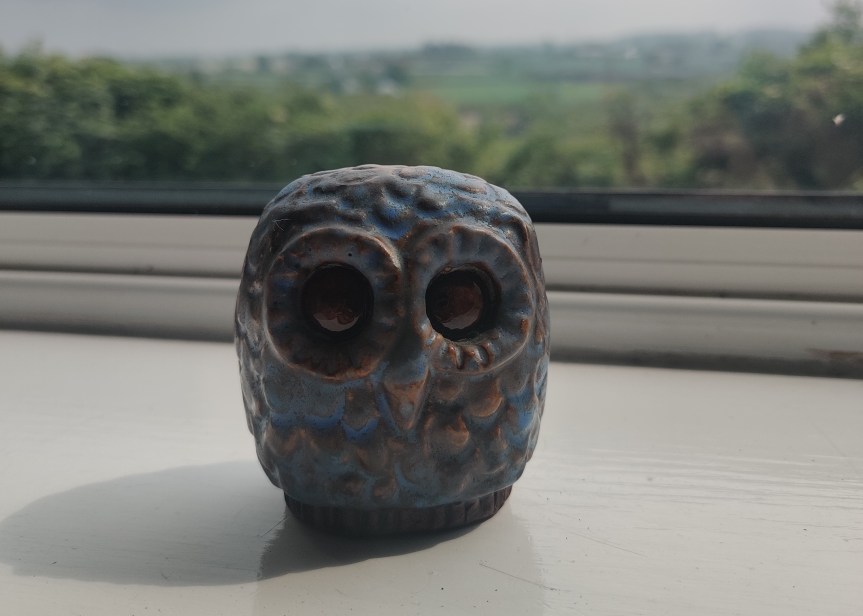
The owls remained, till she passed some years later. They’re now scattered, in a way that things often are when they’re inherited. I picked my favourite (probably Beethoven) – a small blue ceramic one with round, kind eyes and big bushy eyebrows, the number 12 in black marker pen on his bottom. My brother has Mozart, the fluffy hug.

The list is long gone and I’ll never associate owls to music the way Morfar did. But I have named the tawny owl that visits our telegraph pole every evening Beethoven. I think Morfar would have approved. 

Hanne Larsson is a Swede who longs for her childhood’s 95% humidity and hawker centre food. Her stories are fed by moss-covered rock-trolls and what-if scenarios; her non-fiction by nature and what places do to people (and they to them). She is currently completing an MA in Nature and Travel Writing at Bath Spa University.


Birds of Firle is a single edition book by Tanya Shadrick being posted sequentially to 100 collaborators around the world, inviting responses to the idea of Grief and Hope as the things with feathers. Each recipient spends a few days with the book, before returning it with a hand-written letter and other small artefacts.

Enter your email to sign up

Birds of Firle: Words He Gave Me by Annick Yerem


Grief is a language we don’t speak until we have to, with as many variations as you could imagine.

I had already been grieving for so many years, that I thought I was an expert at it. The grief over my healthy body, gone forever, the grieving for the life that could have been. The grief when my son left for Uni and I felt my last purpose was gone.  The grief when my parents got sicker and sicker. The grief when my Dad didn`t recognize me for the first time.

All the unkind firsts.

So when my father died in July 2020, in that strange and horrifying year, I expected to be calm and collected and prepared. But nothing had prepared me for how stressful it would be, how breathtaking and sometimes beautiful my interactions with people would be, how it would crush me and make me laugh and cry and be furious, all at the same time.

The visit to the funeral parlour, where I had to choose an urn and was actually happy to find one that looked vaguely Japanese and not as horrid as the other ones, some of which were adorned with rhinestones, poppies at sunset, that kind of thing (let me tell you, it´s a whole new level of surreal when you get complimented on your choice of urn at your Father`s funeral). The moment I brought them the clothes I wanted him to be cremated in and the woman didn`t know how to tie a kimono, so I had to put it on and show her how. The way she handled my grave gifts with such care: the kimono, the otter t-shirt, the pipe and the tin of tobacco. I felt as I if I was providing safe passage for my own pharaoh in the making.

The woman at the florists whose eyes lit up with delight when I told her I wanted a green wreath and sunflowers and who exclaimed when she saw his photo: ‘I feel that that suits him so well!’

The moment I walked towards the church with my son that morning, the way it smelled of the South of France, of pines and figs and sunshine.  How the tenor practicing the songs for him inside the church sounded like an angel. And how everything fell into place, Bach and Mozart and Schubert, Dylan Thomas and Glyn Maxwell, M’s beautiful words, my letting go, his brother`s lovely eulogy including the accordion, the reverend who had listened to me and painted a picture that was more accurate than what I had expected, the lavender and rosemary we threw on the urn, the tree that has now grown with him, the bramble and rosehip hedges surrounding us, the August heat.

I woke up every night at 4.14 am after he died. After the funeral, it stopped. He sent birds to sing me back to sleep, but first he had to wake me up so that I wouldn`t forget him. He should have known that I remember everything he said to me, the good and the bad.

Grief is a language we don’t speak until we have to, with as many variations as you could imagine.

Sure, we know what it means, when someone dies. But do we? Her and I, we knew all of him. The kindness, the curiousity, the sense of humour. We also knew the temper, the harshness, the slamming of doors, the things that should have been left unsaid. People aren`t easy and he wasn´t either. When I was little, he was my hero, but as I grew older and his expectations weighed on me, we fought and fought, silly, pointless, horrible fights. The last few years though, I fought for him with all I had and I hope that somehow he knew that.

I need him to know that I took so many of the words he gave me and turned them into poems. There are traces of him everywhere.

The house welcomed and woke me with birdsong, and on the balcony were the frayed remnants of skeletons – two who were not so lucky last year. I dared not move them.

On our way to the sea, we saw hundreds of cranes flying to the south, seagulls canvassing the fields. I have to relearn all the birds she taught me when I was little, there are only a few now that I can name. Puffins and starlings, house martins, herring gulls, chicken, owls, buzzards. I keep the bottle of ‘Old Spice’ on my shelf, when I open it and close my eyes, I smell decades of memories.

I remember him and who I maybe was to him and who he was to me. I still do.

Listen on Soundcloud: A reading of St. Eisenberg and the Sunshine Bus, for iamb 

Annick Yerem was born in Japan to a Scottish mother and a German father. She is a poet and editor in chief of Sidhe Press. She wants nothing more right now than a permanent ceasefire in Palestine.


Birds of Firle is a single edition book by Tanya Shadrick being posted sequentially to 100 collaborators around the world, inviting responses to the idea of Grief and Hope as the things with feathers. Each recipient spends a few days with the book, before returning it with a hand-written letter and other small artefacts.

Enter your email to sign up