
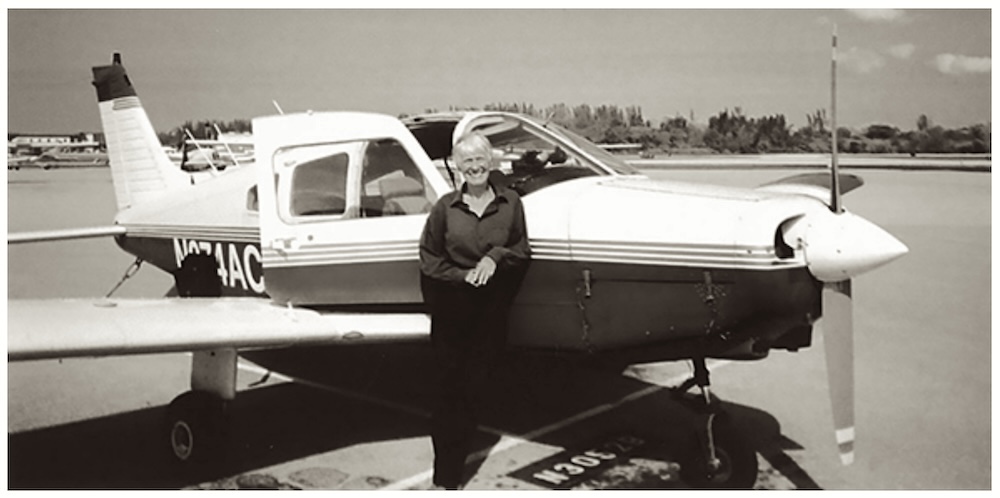
Aerodynamics was her chosen field of engineering. She worked on the Harrier, the Concorde. She had a love of speed and freedom. Sports cars. Like the one in which eventually she fled. Flew. From marriage and family. From us.
When my mother was old, I wrote about her hair as fine white feathers, drifting about her face as she lay on her back each day in the pool, arms outstretched, gazing at the blue southern sky and the whirling Mississippi kites.
She was always associated with flight.
Aerodynamics was her chosen field of engineering. She worked on the Harrier, the Concorde. She had a love of speed and freedom. Sports cars. Like the one in which eventually she fled. Flew. From marriage and family. From us.
When I was young, we lived in a house on a wooded hilltop, named for birds. Three Jays it was called, and sometimes we’d find one of their extraordinary blue, iridescent-barred feathers in the garden, caught in the hedge or the crabapple tree, and we’d bring it inside to her.
All her birds were hilltop birds. But jays are woodland birds; ours are the birds of open sky.
If you were to ask me for a memory of perfect happiness, it would be this: a day of sun and scudding clouds, lying on our backs in the grass on a chalk hilltop, somewhere near the ancient White Horse. Me and her. Listening to skylarks.
It really happened, once or twice, or maybe half-a-dozen times that condense into one. The last was a deliberate, conscious recreation on my part, perhaps as late as 15 years ago, the last time we walked the Ridgeway together. Even then, I was secretly seizing back time and joy against all the years we’d been apart from one another, after she left – and all the years to come, when she would soon be absent again. Most of my life, caught between two mournings. Trying to replay and freeze an image, as sweet and fine and needle-sharp as a skylark’s lifting song on the wind.

Ravens were hers, too. Not the white feathers of her fine-silk hair but absolute and densely black. Both of us claim our true home in the windy places where ravens are. Once we were walking here in Northern California, on the hill I love best, on one of those fiercely blustery winter days when the landscape plays tricks on me in its brief phase of greenness and lowering skies – making my sense of place flicker between here and somewhere along the Pennines or perhaps the Cumbrian fells. Each of my two beloved places interlayering with the other, as if belonging could be as multiple in its objects as love is.
We watched three ravens diving and floating in the hilltop wind, disappearing into the canyon then reappearing together or disparately, passing beside us or above. It was one of her witchy moments, when I knew she was a scientist who would settle for whatever brutal bed she’d made – but also a mystic who knows full well there is more. ‘Have you ever seen a raven roll?’ she asked. ‘I love it when they roll.’ I never had, not for all the times I’d been up there on the ridge in every weather. And at that moment, one of the three dark birds passed close above us and rolled. For nothing but the pure, impractical pleasure of it. The freedom.
It was probably up there, one time or another, that she said she wanted to come back as a raven maybe, or yes, a great raptor. A hawk or eagle. A bird that needs no flock. That moves without apparent movement. That rides the currents of the air, the warm upswells, knows both the play and the science of air, fierce and majestic and profoundly free.
Perhaps the closest she came in this life was training for her pilot’s license, at last, when she had retired and she and her husband were rampaging through the money she’d finally inherited after decades of scrabbling and odd jobs that she always had to hide her credentials to secure. Way back when she’d had her brief, proper career in aircraft design, only the men were taken on test flights. No insurance for women, they said. Gave her a box of Black Magic chocolates instead.
But she never did fly solo, having decided at the last testing hurdle that she was really too old. I suspect it wasn’t really a choice about practicality; it was more about her husband’s wanting to spend the rest of the money on a too-big house in a warm place, with that swimming pool. With the Mississippi kites circling overhead. And her fine white-silk hair drifting about her in the blue water like feathers, which I know it did because I was the one eventually who brushed it out on her pillow, brushed it out with my fingers each night, again and again. As I bent to listen for the weightless lift of her breath.
Nicola Pitchford is a nature writer and academic who was born in the UK and immigrated to the US — and has been confused about landscape and belonging ever since. She lives in the hills of Northern California, on the ancestral land of Coast Miwok people. Her essay about her father’s career in water engineering and his love of desert places, “A Parable of Arable Land,” won the inaugural (2022) Nature Chronicles Prize. She is at work on a book about her early separation from mother and motherland and the attempt to recreate both relationships.
You can order a print copy of The Nature Chronicles anthology – which includes Nicola’s winning essay ‘A Parable of Arable Land’ – from Sarabande Books.
Birds of Firle is a single edition book by Tanya Shadrick being posted sequentially to 100 collaborators around the world, inviting responses to the idea of Grief and Hope as the things with feathers. Each recipient spends a few days with the book, before returning it with a hand-written letter and other small artefacts.
 selkiepress.com